
Barrister Hassaan Salahuddin | Managing Partner, Salahuddin, Saif & Aslam (Attorneys at Law)
A licence is only half of a workable launch in Pakistan. The other half is a bank account. Pakistan has moved from restricting banks’ dealings in virtual currencies to permitting banking relationships with licensed virtual asset service providers (“VASPs”), which is a significant step for market entrants. But permission to open an account is not the same as a bankable operating model. Licensing scope, customer-fund segregation, due diligence and cross-border flows all still have to be addressed.
A new banking pathway, not unrestricted access
On 6 April 2018, the State Bank of Pakistan (“SBP”), through BPRD Circular No. 03 of 2018, directed regulated entities to refrain from dealing in virtual currencies and to report relevant customer transactions as suspicious. Eight years later, BPRD Circular Letter No. 10 of 2026, dated 14 April 2026 (the “SBP Circular”), replaced that circular with immediate effect.
Against the backdrop of the Virtual Assets Act, 2026 and the establishment of the Pakistan Virtual Asset Regulatory Authority (“PVARA”), the SBP Circular permits SBP-regulated institutions to open accounts for PVARA-licensed VASPs, subject to specified conditions. Those conditions are commercially consequential.
1. Banking eligibility follows the licence
Under paragraph 3(a) of the SBP Circular, before onboarding a VASP or commencing activities with it, a bank must obtain the PVARA licence and verify its authenticity directly with PVARA. A copy supplied by the applicant does not replace independent verification.
In practice, a VASP should present the bank with a clear map of its proposed services and transaction flows, aligned with the activities authorised by its PVARA licence. The proposal should distinguish the VASP’s operating funds from customer money and identify any intended cross-border flows.
2. Customer money must be segregated
Where the business model requires them, paragraph 3(b) of the SBP Circular requires banks to open separate customer money accounts (“Customer Money Accounts”) for settlement of authorised transactions. These must be strictly segregated from the VASP’s other accounts, and commingling of VASP and customer funds is prohibited. Paragraph 3(c) of the SBP Circular places further restrictions on Customer Money Accounts:
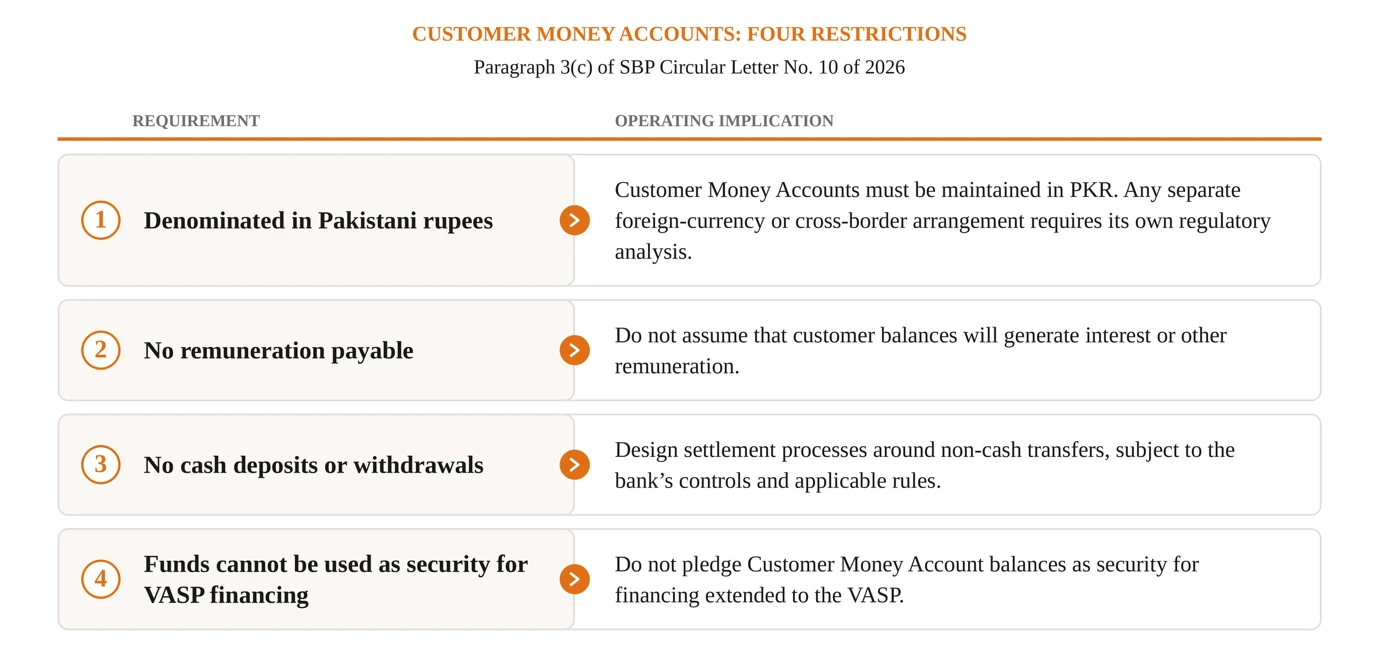
Together, these restrictions shape how a VASP can settle customer transactions, what it can expect to earn on balances and what it can offer a lender.
The SBP Circular does not set out detailed procedures for deducting VASP fees from customer balances or reconciling Customer Money Accounts. Any proposed fee-deduction mechanism and reconciliation process should be documented and reviewed with the bank before transactions commence, while preserving segregation and compliance with applicable requirements.
3. A no-objection certificate opens a narrow door
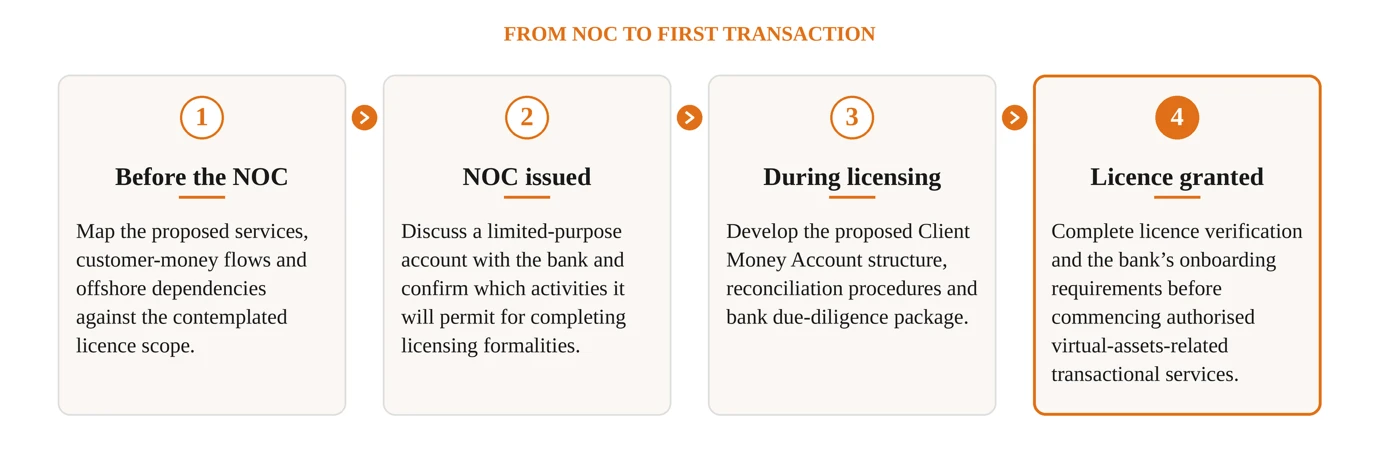
Paragraph 5 of the SBP Circular permits a company holding a PVARA no-objection certificate (“NOC”), but not yet a licence, to obtain a limited-purpose account to complete licensing formalities. It does not permit the company to conduct virtual asset transactions. Additional services become available only after the licence is granted, subject to the SBP Circular’s conditions.
The SBP Circular does not specify a detailed list of permitted transactions for the limited-purpose account. Applicants should agree with the bank which activities are necessary to complete licensing formalities and should not use the account for virtual-assets-related transactional activity before obtaining the PVARA licence.
4. Expect detailed scrutiny of the business model
Paragraph 4 of the SBP Circular requires banks to develop an enhanced understanding of the VASP’s business, activities, customer onboarding, customers and markets, in addition to ordinary anti-money-laundering due diligence. Banks must update risk profiles, monitor the relationship and report suspicious transactions in accordance with applicable law.
A coherent regulatory narrative matters. Ownership, control, transaction forecasts, customer categories and source-of-funds explanations given to the bank should be consistent with the PVARA application. Inconsistencies can delay an otherwise viable launch.
5. The offshore settlement question remains
Paragraph 6 of the SBP Circular continues to prohibit banks from investing in, trading or holding virtual assets using their own funds or customer deposits. Separately, paragraph 7 preserves compliance with other applicable SBP requirements, including foreign-exchange rules. Opening a local bank account therefore does not, by itself, authorise remittances to an offshore exchange or overseas group entity. The legal basis for each proposed cross-border flow must be assessed separately.
For international exchanges entering Pakistan, the movement of funds between a local VASP and an overseas group company warrants separate structuring and early bank engagement. For many, this will be a foreign exchange question first and a virtual asset question second. It should be resolved before launch, not treated as an operational detail after licensing.
From NOC to first transaction: a practical sequence
Conclusion
SBP Circular Letter No. 10 of 2026 is an important step towards a regulated virtual asset market in Pakistan. But it does not create an unconditional right to banking services. Banks retain discretion to assess and accept VASP relationships.
For international VASPs, four workstreams should therefore progress together from the outset: the licence perimeter; the Pakistani entity and account structure; customer-money account structure and segregation; and the legal basis for any cross-border movement of money. An attractive licence application can still produce an unworkable operating model if banking arrangements are considered only at the end.
This article provides general information on the regulatory framework discussed and does not constitute legal advice. The appropriate approach will depend on the proposed activities, licence scope, banking arrangements and applicable requirements.
About the author
Barrister Hassaan Salahuddin is Managing Partner at Salahuddin, Saif & Aslam (Attorneys at Law). His practice focuses on fintech, financial services regulation, licensing and transactions, including the regulatory framework for virtual asset businesses in Pakistan.